Award-winning photojournalist
James Morgan recently documented the destructive fishing methods of the Bajau
Laut – driven by fish stock depletion, the Bajau sea nomads learnt to devise
bombs by filling up bottles with ground matchstick heads, sand and fertilizer. Not only do these explosives kill all fish
within radius of the explosion, they also detonate the coral reefs below. Now
bombs have fallen upon one of the richest marine sites in the world - Raja
Ampat – an archipelago of 610 islands surrounded by coral reefs, in far Eastern
Indonesia.

The idyllic islands of Wayag in Raja Ampat
It’s
hard to imagine. For hundreds of years the
locals of Raja Ampat have implemented a management system that protected their
natural resources, known as sasi –
areas were temporarily closed to all fishing activity for periods of 6 months
up to 5 years, to protect the area from exploitation. Some communities held sasi over marine wildlife such as the sea cucumber and lobster, to
give the species time to re-populate. Benefiting
of all members of the community, the system ensured that there was always a
fish on the plate for tomorrow and for their children’s tomorrow. Yet the dynamics of Raja Ampat have rapidly
changed over the last 10 to 20 years with a government-directed transmigration
program in progress and non-sustainable, illegal fishing techniques have been
introduced.
The coral
reefs outside of the protective gaze of resorts and conservation posts are
likely to be the most vulnerable. In the
quiet village of Meos Mangara in far Western Raja Ampat, the locals spoke about
the empty island of Jefmoi where white sands glistened beneath a parade of overhanging
coconut trees. However the island’s
reef, (located just outside of a no-take fishing zone) had been destroyed by
bombs. White fragments of soft coral
were piled across the ocean floor – hard corals were split and the landowner’s dream
of opening a home-stay had quite literally been shattered.

A boy from Meos Mangara scoops up a piece of shattered
coral
The
locals of Meos Mangara (meaning Ant Island in the local dialect) explained that
bombers often targeted small islands with no inhabitants, in order to evade
their vigilant watch. It is believed
that fishermen from Sorong and Buton in Sulawesi have used home-made bombs to
fish since the 1990s – only this year no explosions were heard by the
villagers. Yet although no-take zones and
government and community surveillance teams have been established, the
villagers in Meos Mangara complained that many patrol posts were left unguarded. As corals perish, the fishing stocks deplete
and the villagers experienced difficulties finding food on an island that used
to yield plenty.
In
Waisai, the capital of Raja Ampat, there was little evidence of bombed fish entering
the market. Some of the locals at the
harbour explained that bombed fish were usually sold in Sorong and the mainland
where the damaged fish could be traded unnoticed, in a large-scale market. When fish have been bombed, the bones
shatter, detach and the fish become floppy.
Another clue to look for in the market, they explained, was a large
amount of fusiliers (lalosi) and mackerel
(lema / kembung). These fish are targeted because they school
in large numbers, often near coral.
Noticing
the depletion of lema stocks – a new
campaign by the government of Raja Ampat, Conservation International (CI) and
RARE, has developed and CI staff member Bertha Matatar explained that
“Fishermen are encouraged to refrain from catching the lema during the spawning period of September to November”
Sustainable
fishing methods are often used by the locals and the inhabitants of Salawati (one
of the four main islands of Raja Ampat) used underwater fishing cages called keramba.
Erected close to the beach with a tunnel at the front, fish were
able to swim into the cage, but not back out.
When the locals required fish, they simply scooped out the live catch
with a net and all infants were thrown back into the sea in order to mature. Villagers also held sasi over the lobster, since according to folklore, the lobster once
guided lost fishermen back to the shore – no-one is allowed to eat the lobster
and if it is accidently caught in the net it must be thrown overboard.
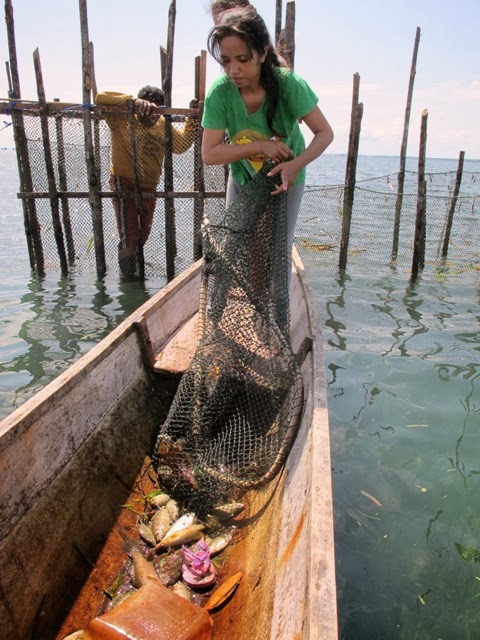
Dinner in Salawati: the catch from the keramba nets is tossed into the boat
Yet
Salawati’s hidden corals were also victim to illegal fishing practices and
officers at a nearby Conservation International post explained that the reef by
the post had been bombed in the past and was beginning to recover after years
of surveillance.
According
to research by renowned marine scientist Gerald Allen, the locals are now applying
non-sustainable fishing methods such as cyanide which is supplied to them by
non-locals along with a squirt-bottle.
After CI scientists investigated the conditions of 45 coral reefs over
10 years ago they discovered that 13.3% showed evidence of destructive fishing
practices. Patrols and surveillance
posts are crucial and CI has established many stations across Raja Ampat. Even the idyllic region of Wayag was bombed
in the past and only now, (under the protection of CI) has the area flourished
with black tip reef sharks. However, CI
rangers explained that illegal boats from the Philippines were caught entering
Wayag’s waters - these hunting boats were often armed and dangerous and packed
with shark fins to trade illegally in Asia.
Due to global fishing pressures, nets are now being flung further East,
into one of Indonesia’s last remaining paradises - Raja Ampat. For hundreds of years the respectful
islanders have lived in harmony with the marine world, yet in just the past 20
years this relationship has faced many strains. A firm understanding of the impacts of
bombing, coral destruction and fish stock depletion needs to be understood by
every fisherman, before the paradise is lost.
Further Information
Conservation International: http://www.conservation.org/
McKenna, S.A., G.R. Allen, and S. Suryadi (eds.). (2002) ‘A Marine Rapid
Assessment of the Raja Ampat Islands, Papua Province, Indonesia.’ RAP Bulletin
of Biological Assessment 22. Conservation International
James
Morgan’s documentary: http://www.jamesmorgan.co.uk/film/people-of-the-coral-triangle/


