Tuesday, August 27, 2013

Raja Ampat - the Culture that Arose from 610 Islands

Every October, Raja Ampat hosts its annual cultural festival.  All of these photos were taken on the 18th October.  


Women perform the yosim dance with bamboo flutes and drums.  The traditional drum of mainland Papua is known as a tifa and is often made with the skin of the monitor lizard.  


Two men are adorned with the traditional accessories and body paint of Yenbekaki Village in Raja Ampat. The head dress is a made from a red bird-of-paradise which is protected on the island from hunting. Old stuffed birds like these are passed down from generation to generation, in mainland Papua, they are stored in bamboo containers and stored in the smokey roof - conservation groups provide 'moth balls' in order to preserve the specimens and prevent the need to hunt them.

Like the famous naturalist and explorer Alfred Russel Wallace, many tourists still flock to Raja Ampat to see these captivating birds of paradise.  Endemic to the islands of Waigeo and Batanta are Wilson’s Bird-of-paradise as well as the Red Bird-of-paradise.
Other birds worth spotting include: sunbirds, kingfishers, Papuan hornbill, cockatoos, parrots, the rainbow lorikeet, ospreys, egrets, the white bellied sea-eagle, Gurney’s eagle, hawks and owls.

The following article offers a good reason why you should come to Raja Ampat - quite simply it is the best place in the world to go snorkeling:
http://www.gonomad.com/2125-indonesia-s-raja-ampat-islands-the-best-snorkeling-in-the-world
In this article Larry Taylor describes his experiences of traveling through Raja Ampat on a shakti boat - an Indonesian, traditional vessel.

Weaver Ants Build their Castles in the Trees

In our back-garden in Papua, hidden in the vines and the orange tree is a hidden civilization.  Weaver ants are strange creatures that build vast networks of homes in the trees - using leaves!!  The nests are woven together and sealed with larval silk and colonies can include up to 100 nests. By firmly grasping and manipulating a larvae, the worker ants are able to bind the leaves together.
In Thailand, these leaf-larvae packages are even sold as food items in markets and the larvae are said to be high in protein. I think I'll pass on that though.

The simplest leaf design - a leaf folded upon itself and sealed at the edges. 

The worker ants have exceptionally good communication skills -using chemicals or tactile communication signals (such as body shaking.)

A more complicated nest design in a vine plant.  Some larger nests have been recorded as measuring half a metre in length.

Tuesday, December 20, 2011

Cheap and Eco-friendly Refrigerator


In our home we decided to make our own fridge from clay pots and below are instructions on how we did. It was cheap to do, costing us around IDR 200,000 and it’s good for the environment too. 

Nowadays fridges in Europe usually contain HFC-134a which does not deplete the ozone layer (although it is a greenhouse gas). This substance replaced CFCs which were responsible for depleting the ozone layer. However, in Indonesia I struggled to find a fridge which didn’t contain CFCs and I didn’t think that HFCs were a good alternative since all halocarbons are powerful greenhouse gases. 

So we researched alternative ways to keep our food cool and found out about an ancient type of fridge made of terracotta pots called a Zeer pot which is used across the Middle-East and Africa. A similar terracotta fridge is also used in Indonesia - our neighbour in Malang, East Java have a clay pot fridge which they sunk into the soil in their garden in order to keep it extra cold.
To make your clay pot fridge you will need:
Two unglazed terracotta (clay) pots
A bag of sand
A towel
Water
We found the clay pots in a market close to Brawijaya University in Malang, East Java.
The large outer pot - first we filled it with sand.
Then we placed a smaller clay pot inside and filled the sides with sand until the sand reached the tops of the pots.
After we had filled in the sand we poured water into the sand until it was moist. Then we placed a moist towel over the top of the two pots. Fruit, vegetables and cheese will now keep for up to a week. The sand needs to be watered once or twice a day. And voila... a new fridge.

Thursday, November 24, 2011

Plants from Central Kalimantan: a Dayak Perspective

In the month of June 2011 I took photos of plants in the Pasir Panjang forest of Central Kalimantan. The indigenous Dayak people of this region have an intimate knowledge of the plants which grow in their forests. For centuries plants have provided the Dayak people with medicene, food, even water. Here is a list of some of these plants and the ways in which the Dayak people used them in the past as well as today. Since I was volunteering at the OFI Care Centre and Quarantine, a rehabilitation centre for orangutans I have also mentioned whether these plants are eaten by orangutans as well.

Local name: Putat

Habitat / Biological Information: The fruits of this plant are red and yellow.

Interesting fact: A traditional Dayak medicine can be made from the leaves of the putat plant to make an ointment that can be rubbed onto the skin, to relieve skin irritated by the rangas tree.

In the Photo: Baby Hunt is climbing in the forest surrounding the nursery, and white putat flowers can be seen sweeping down on his right-hand side.


Putat continued….

In the Photo: Baby Hunt is eating either Putat flowers or leaves in the forest outside the baby nursery.


Local Name: Lembiding (kelakai - alternative Dayak name)

Habitat / Biological Information: Lembiding is a vine and the young leaves grow in crosier. Young and juvenile leaves are red and soft, adults leaves are hard, green and have serrated edges.

Interesting fact: Orangutans eat the young, red leaves and tips of the vine. Local people also eat the leaves, by soaking them in hot water first to soften them, before frying them. Dayak people believe that the lembiding plant is good to eat if you have low blood pressure.

In the Photo: Sidney can be seen enjoying eating the tips of the Lembiding vine.

Local Name: Unknown (possibly Kelombang)

Habitat / biological information: A small, aquatic plant which grows with its leaves floating on the water. Its flowers grow upright, sticking out of the water and growing up to 10-20 cm. The flowers are purple on the outside and yellow on the inside and smell like dirty socks. The leaves are green on the top side of the leaf and purple underneath.

Interesting fact: This plant is poisonous if consumed.

Local Name: Ngang Garam

Interesting fact: Orangutans can eat the fruit of this plant.

Local name: Selinsing

Habitat / Biological information: Selinsing grows in water.

Interesting fact: Local people use this photographed species as a medicine for itchy skin.

In the Photo: Wallis can be seen eating the grass in the forest.

Local name: Tabiku Tingang, Kantong semar (Indonesian) or pitcher plant (English)

Genus: Nepenthes

Habitat / Biological Information: Pitcher plants have a unique way of feeding. They have evolved to live in areas with low nutrient soils by getting their nutrients from insects. Insects are lured to eat from the lid of the plant but once they enter the pitcher of the plant, the slippery sides ensure that the insects can’t climb back out. After the insects plummet into a pool of water at the bottom of the plant, the plant secretes enzymes into the water which digest the insect.


Tabiku Tingang continued….

Interesting fact: One species, the red crab spider, has developed a way to survive off the pitcher plant. By hanging on with threads of silk to the sides of the plant, it waits for a trapped insect in the pool of water to drown before eating it. Using an air bubble, the spider can even dive into the water to catch swimming larvae.

Tabiku Tingang continued….

Interesting fact: In Dayak, Tingang translates as hornbill, therefore the name of this particular species of pitcher plant, Tabiku Tingang, derives from the shape of its hood which locals believe resembles the shape of a hornbill. Before there was adequate access to water in Kalimantan, local Dayak people would often drink from the pitcher plant whilst in the forest. Birds will often drink from this plant too.

Local name: Singkong (Indonesian), cassava (English),

Species name: Manihot esculenta

Interesting fact: This plant is native to South America but is commonly cultivated in tropical, sub-tropical regions such as Indonesia. Cassava is now considered to be the third largest source of carbohydrates in the world for meals. Various parts of the plant are edible such as the tapered root, the leaves and the juices.

In the Photo: Here, Berman can be seen eating the Cassava.

Local name: Kaladi

Interesting fact: People and orangutans can’t eat this plant because it is poisonous. It can make the skin very itchy as well.

Local name: Karamunting kodok

Interesting fact: Local Dayak people in Pasir Panjang cook and eat the flowers of this plant. They can also eat the fruit if it’s ripe and red.

In the Photo: Douglas Soledo can be seen enjoying a ripe Karamunting fruit.

Karamunting Kodok continued....

In the Photo: Here, baby Britney is enjoying a younger Karamunting fruit which is still green.

Local name: Angrek (Indonesian), Orchid (English)

Interesting fact: Sometimes orangutans will eat these flowers.

Local name: Jamul, (Indonesian name for fungus) the generic name is shelf fungus or bracket fungus.

Interesting fact: Orangutans don’t eat this particular fungus, but they will often eat other fungi. This fungus is poisonous. Dayak people believe that if a caterpillar is eating a fungus, then it is safe for people to eat too.

Local name: Akar (Indonesian), Liana (English)

Habitat / Biological Information: Lianas are woody vines that rely on other plants for support in order to reach the heights of the canopy where more light can be found. Rooted, they start from the ground, and because they don’t need to invest energy into structural support, they devote more resources into leaf production and stem elongation for rapid growth. Some lianas have been recorded as exceeding 3,000 feet in length. Lianas are very important in the forest; they suppress tree regeneration, provide food to animals, and physically link trees together, providing passage through the canopy for arboreal animals such as orangutans.

In the Photo: Sidney relaxes on a sturdy, old vine.

Local name: Pohon Nanasi

Interesting fact: Orangutans sometimes eat the fruit from this tree. Nanasi translates as white rice in Dayak, and so the name of this plant derives from its color which is similar to white rice.


Local name: Satar

Interesting fact: The young blue leaf turns green and orangutans eat the young leaves and Satar fruit.


Local name: Akar (Indonesian), Vine (English)

Interesting fact: This is a young vine, making its way up a tree. Vines have many tactics for attaching themselves to a host. These include methods such as stem twining, using tendrils from their stems, thorns, spikes or downward-pointing hairs to stick to their host.

Thursday, November 17, 2011

Javanese Tiger – extinct in the wild, extinct in our minds?

Whilst trawling through the internet trying to find information about the Javanese tiger I was surprised to discover that although the species became extinct in the mid-1970s there is very little research about the tiger and few images too. I recently bought an interesting conservation book called Berkaca di Cermin Retak from the Indonesia School of Photography bookshop in Malang which stocks books about poetry, literature, science, politics, psychology, sociology and many more subjects.

In this book I found an image of a Javanese tiger specimen on exhibit at the National Museum of Natural History in Leiden. The book explained that there are now only 7 skin specimens of the Javanese tiger in the world. There are 3 specimens in the Museum Zoologicum Bogoriense in Bogor, 2 in the Museum Leiden in The Netherlands, 1 in England and 1 in France. Later the book asks: how many private collectors out there have their own stuffed tiger? I wonder if these collectors knew their role in the tiger’s demise?

Javanese tiger specimen. Copyright Ed Colijn from the book Berkaca di Cermin Retak by Wiratno, Daru Indriyo, Ahmad Syarifudin and Ani Kartikasari. Published in 2001 by FOReST Press, The Gibbon Foundation Indonesia and PILI – NGO Movement.

Tuesday, November 1, 2011

Wildlife in Central Borneo from a Dayak Perspective

From April until June 2011 I tried to capture some of the rich wildlife that made the forest surrounding the OFI Care Center in Pasir Panjang, Central Kalimantan, its home. Yet this photo reel barely scratched the surface since the biodiversity in the forest was overwhelming. Dayak are the native people of Borneo and their knowledge of their forest and its inhabitants was historically important for their survival within the forest. Here is a compilation of Dayak knowledge concerning each of these creatures photographed within the forest. All names are written in the Pasir Panjang Dayak dialect unless otherwise stated.

Thanks to Pak Sia and Mr Henson for their help with the identifications. All photos copyright Tess Joyce and Orangutan Foundation International.


Local name: Keminting Sesandah, Pil kaki seribu (Indonesian) Pill millipede (English)

Habitat / Biological Information: Only found in South East Asia. Pill millipedes look similar to woodlice, except they have 13 body segments whereas woodlice only have 11.


Keminting Sesandah continued….

Interesting fact: If they are in danger they roll into a tight ball. This process is known as conglobation.


Local name: Rariau, Reriang (Indonesian), Cicada (English)

In the photo: This particular species of cicada has yellow eyes, but many cicadas have reddish eyes. Only a small number have yellow, white or blue eyes so this particular cicada was quite a rare find.


Local name: Sepucung bejopan, Ulat kantung (Indonesian) Bagworm (English)

Family: Psychidae

Habitat / Biological Information: Only female bagworms create of bag of sticks to live in. After they mate, they turn around in the bag, lay their eggs and die; their remains become food for the larvae.

In the photo: The female worm’s head can be seen poking out the top (looks like a sausage). This bagworm was seen dangling from a branch suspended from an ultra-fine silk.


Sepucung bejopan continued….

Habitat / Biological Information: The male bagworms have well-developed wings and can fly long distances looking for a mate. They live long enough to find a mate and then die, since their lack of mouth-parts prevents them from eating.

In the photo: Here, the female bagworm is attached to the side of the boardwalk in the jungle. The worm inside is not visible in this particular photo.


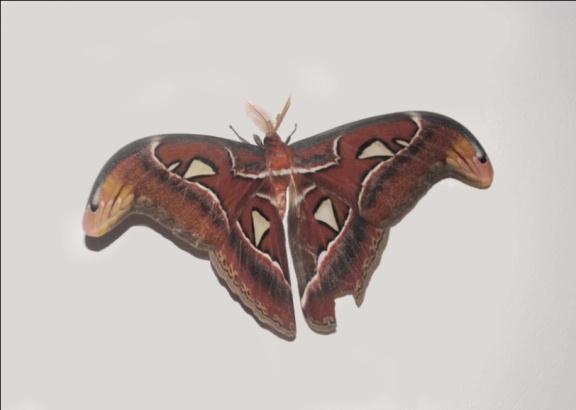
Local name: Bamba serawai, Kupu kupu malam (Indonesian) Atlas moth (English)

Species name: Attacus atlas

Habitat / Biological Information: Atlas moths are considered to be the largest moths in the world in terms of total wing surface area. Their wing spans can reach up to 30 cm in length.

Bamba serawai continued….

In this photo: Pak Sia, who is in charge of the diets of the orangutans, puts his hand up against the wall for comparison. Unfortunately Pak Sia has very large hands, which reduces the impact of the size of this exceptionally large moth!


Local name: Bunta sombah, Belalang sembah (Indonesian) Praying mantis (English)

Habitat / Biological Information: This particular species prefers hiding in green leaves where it can safely camouflage.


Local name: Bunta rating, Belalang ranting (Indonesian) Stick insect (English)

Order: Phasmatodea

Habitat / Biological Information: The greatest diversity of stick insects can be found in Southeast Asia and South America. Their greatest defense mechanism is camouflage and many replicate sticks or leaves. Some even perform a rocking motion which is thought to mimic swaying leaves or twigs. Other stick insects avoid predation by feigning death, and enter a motionless state for a prolonged period of time.

Local name: Kuwai, Bunglon (Indonesian), Chameleon (English)

Interesting fact: This species can change color; its blue color matches the tiles beneath. Another, smaller species of chameleon in the OFI forest has a stretch of skin between the legs which it uses to fly through the trees.

In this photo: This chameleon was caught by a cat in the veterinary clinic, part of its tail was missing. As a last resort many lizards are able to shed their tail.


Local name: Songki, Tupai (Indonesian), Squirrel (English)

Interesting fact: When I discovered two baby squirrels had fallen from their nest, one of the OFI staff members, Mr Henson, was very concerned. He explained that unprotected baby squirrels or other small animals are stung from the abdomen by fire ants, releasing a toxic alkalid venom before they are slowly digested. So we made the baby squirrels a makeshift nest high in the tree away from the ant-infested floor.

Local name: Konsit, Burung madu (Indonesian), Sun bird (English)

Family: Nectariniidae

In the photo: This sun bird spent all morning trying to get through my bedroom window by tapping the glass with its beak. When the window was open, it sat on the metal trellis, singing and peering into the room. It was later seen perched on my straw sun hat, so perhaps it was looking for nesting material. The top half of its body was bright red in color and it had a curved beak.


Local name: Kora, Monyet ekor panjang (Indonesian), Long-tailed macaque (English)

Species name: Macaca fascicularis

Habitat / Biological Information: Long-tailed macaques have been recorded as living in groups of between 6-58 individuals.

Interesting fact: They have an extensive range of vocal communication for many different situations. “Harsh” calls are used to show alarm, and “clear” calls promote friendly interactions. The long-tailed macaques can often be heard calling in the OFI Care Center forest. Often, some of the released orangutans will stop in their tracks and timidly listen to the calls of the macaques.


A different location: Camp Leakey, Tanjung Puting National Park, Central Kalimantan

Local name: Benayan, Biawak (Indonesian), Monitor lizard (English)

Genus: Varanus

Interesting fact: Varanid lizards are believed to be very intelligent, and some species in zoos have shown abilities to distinguish numbers up to ten.


A different location: Camp Leakey, Tanjung Puting National Park, Central Kalimantan

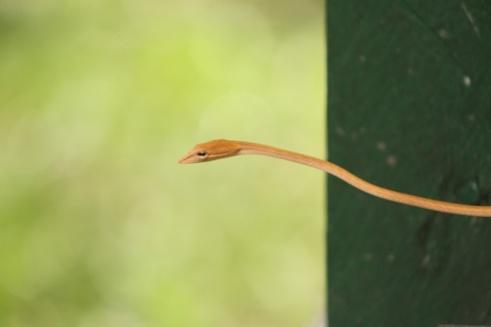
Local name: Ular daun (Indonesian), possibly a green and brown tree snake (English)

Thursday, October 27, 2011

Palm Oil Everywhere

Indonesia is now the third largest of emitter of carbon in the world. Why? Because of deforestation. Why? To feed the West’s demand for cheap bio-fuel made from palm oil. Palm oil plantations are now big businesses, and are taking over Sumatra and Kalimantan. Yet there is huge price to pay for this booming business – global warming, since it is largely peat rainforests which are burnt to make room for the plantations. Willie Smits who has now begun a reforestation programme in Indonesia explains further;

And those are the peat swamp forests on 20 meters of peat, the largest accumulation of organic material in the world. When you open this for growing oil palms you're creating CO2 volcanoes that are emitting so much CO2 that my country is now the third largest emitter of greenhouse gasses in the world after China and the United States, and we don't have any industry at all. Only because of this deforestation.

To view his whole speech, please visit:

http://www.ted.com/talks/willie_smits_restores_a_rainforest.html

So according to the economic model of supply and demand, we can all help a little bit to curb this destructive cycle of deforestation – by decreasing the demand for palm oil products every time we visit the supermarket. Palm oil is a cheap product which is now being used in everyday items such as potato chips, soap, chocolate and cooking oil. The problem is being able to detect it since palm oil companies are getting clever and the oil is rarely printed as simply palm oil, but can be called various names such as “vegetable oil”. In fact nearly all products made in Asia which use the term “vegetable oil” contain palm oil. A comprehensive list of alternative names for palm oil as well as products which contain palm oil can be found here:


http://www.saynotopalmoil.com/palm-oil.php


So what can you eat in Indonesia?

Most cooking oils that I have come across are made from palm oil. So I’ve swapped for a tastier and healthier option – olive oil, although sunflower oil is another commonly found alternative option.

Bertoli Olive Oil bought in Jogjakarta, Java.

Olive oil is mainly grown in the Mediterranean although Australia now produces a large quantity which is now being imported to Indonesia. Produce imported from Australia would have a smaller carbon footprint too since it requires to less air miles to transport the product to Indonesia. I bought this bottle of Bertoli in Jogjakarta in a shop called Waroeng Steak and Shake. Olive oil can also be found in health food stores, large supermarkets as well as international shops. In Malang, East Java the market Lai Lai stocks olive oil and Australian olive oil. In Surabaya, East Java, I have seen various supermarkets containing olive oil.

This golden oil is also good for your health since it contains antioxidants which are not found in other oils. It is also high in monounsaturated fats; diets high in levels of monounsaturated fats have been linked with reduced risks of coronary heart disease.

So what are you waiting for...why not try a light olive oil to fry your bread in the morning? It might taste strange the first few times, but after that you’ll be hooked like me and there’s no going back...