Sunday, November 16, 2014

Treating Paresthesia (or Toothache) with Cloves


In March this year I had my wisdom tooth extracted – for a while I had applied ground cloves on the tooth which had failed to penetrate through the gum, leaving a painful ‘flap.’  The cloves helped to relieve the pain, however after a few months, the flap hadn’t shown any signs of healing and so I went to one of Bali’s best dental hospitals.  With just one look at my wisdom tooth (lower left) the dentist told me he needed to take it out.  The operation was quick, and no x-ray was performed to check the tooth’s proximity to the mandibular nerve which runs along the lower jaw, or its branch-off nerve, the lingual.

The post-operative healing was successful, however I soon noticed a numbness and tingling sensation which steadily grew over the months.  This is a condition known as paresthesia and eight months after the operation, it has become extremely persistent – my lower and upper lips tingle, my mouth feels numb and the whole sensation feels uncomfortable.  Paresthesia is caused by nerve damage during the extraction process and as a result, a nerve may be bruised, stretched, crushed or severed.

In most cases, paresthesia should clear up after a few days or weeks after the operation – however for some, the condition is transient – lasting for more than 6 months.  In a few cases, it has been known to be permanent.   However it is recommended to wait for up to 12 months after surgery in order to wait for the nerve to repair naturally before treatment (surgery) on the nerves is recommended.

So here I am, eight months in, and the numbness and tingling sensations are steadily increasing.  Each day I meditate to learn to relax and not react against these sensations by focusing on my breath and I am now applying ground cloves onto the gum area which is reducing the symptoms. 

A quick Google search about the wisdom tooth extraction industry highlights the concerns – many operations have been completely unnecessary.  Some holistic doctors recommend focusing on your diet and nutrition as a way to strengthen the jaw bone, providing space for all the teeth.  More information on this topic can be found here:

Yet why Cloves?  Along with nutmeg and mace, cloves originated from Maluku (the Spice Islands) and were highly coveted throughout history – in 1522, Spain was the first to circumnavigate the globe to reach the Spice Islands of Indonesia and over the centuries the powerhouses of Europe competed to gain control over the spice market.  Cloves and other Indonesian spices were highly prized and became a status symbol in wealthy households. 

Used as a treatment for toothache for centuries – cloves and clove oil contain eugenol which has anti-bacterial and anti-inflammatory qualities and it inhibits the growth of fungi.  Yet care should be taken when applying the oil - essential oils should never be applied directly to the skin or consumed.

In Indonesia today, cloves are mostly grown to supply kretek (clove cigarette) manufacturers, and the plant’s health benefits have largely been forgotten by the general public – even in America, the U.S. Food and Drug Administration (FDA) has reclassified eugenol, downgrading its effectiveness rating in its treatment of toothache – further demonstrating just how much power the medical industry holds and its ability to downgrade the Earth’s healing plants.  

So please, if you have problems with your wisdom teeth, please consider the natural alternatives before you put your faith in any profit-making industry.

Update - Success with Treating the Paresthesia:
For the past week I have been doing a raw juice detox - everyday I've been consuming carrot, beetroot and turmeric juices along with lots of fruits.  After seven days, I noticed that the paresthesia seemed to have been aggravated and the sensations were increasing - I have read that this is a common sign of the healing process during a detox, if the wound becomes aggravated.  I applied a tiny amount of clove oil on the gum with a cotton bud, which was red and sore (I have read that this can be dangerous to apply the oil directly to the gum since it can deaden the nerves) - my whole mouth felt smooth and clear and the sensations began to dissipate.  Now, five days on, my mouth is beginning to heal, the sensations have reduced considerably and the site of the wound is no longer red.

A clove farm near Halimun National Park, West Java

 Clove trees in West Java

Friday, February 28, 2014

Trouble in Paradise: The Coral Reefs of Raja Ampat


Award-winning photojournalist James Morgan recently documented the destructive fishing methods of the Bajau Laut – driven by fish stock depletion, the Bajau sea nomads learnt to devise bombs by filling up bottles with ground matchstick heads, sand and fertilizer.  Not only do these explosives kill all fish within radius of the explosion, they also detonate the coral reefs below.  Now bombs have fallen upon one of the richest marine sites in the world - Raja Ampat – an archipelago of 610 islands surrounded by coral reefs, in far Eastern Indonesia.
 The idyllic islands of Wayag in Raja Ampat 

It’s hard to imagine.  For hundreds of years the locals of Raja Ampat have implemented a management system that protected their natural resources, known as sasi – areas were temporarily closed to all fishing activity for periods of 6 months up to 5 years, to protect the area from exploitation.  Some communities held sasi over marine wildlife such as the sea cucumber and lobster, to give the species time to re-populate.  Benefiting of all members of the community, the system ensured that there was always a fish on the plate for tomorrow and for their children’s tomorrow.  Yet the dynamics of Raja Ampat have rapidly changed over the last 10 to 20 years with a government-directed transmigration program in progress and non-sustainable, illegal fishing techniques have been introduced.

The coral reefs outside of the protective gaze of resorts and conservation posts are likely to be the most vulnerable.  In the quiet village of Meos Mangara in far Western Raja Ampat, the locals spoke about the empty island of Jefmoi where white sands glistened beneath a parade of overhanging coconut trees.  However the island’s reef, (located just outside of a no-take fishing zone) had been destroyed by bombs.  White fragments of soft coral were piled across the ocean floor – hard corals were split and the landowner’s dream of opening a home-stay had quite literally been shattered.
 
A boy from Meos Mangara scoops up a piece of shattered coral
The locals of Meos Mangara (meaning Ant Island in the local dialect) explained that bombers often targeted small islands with no inhabitants, in order to evade their vigilant watch.  It is believed that fishermen from Sorong and Buton in Sulawesi have used home-made bombs to fish since the 1990s – only this year no explosions were heard by the villagers.  Yet although no-take zones and government and community surveillance teams have been established, the villagers in Meos Mangara complained that many patrol posts were left unguarded.  As corals perish, the fishing stocks deplete and the villagers experienced difficulties finding food on an island that used to yield plenty.

In Waisai, the capital of Raja Ampat, there was little evidence of bombed fish entering the market.  Some of the locals at the harbour explained that bombed fish were usually sold in Sorong and the mainland where the damaged fish could be traded unnoticed, in a large-scale market.  When fish have been bombed, the bones shatter, detach and the fish become floppy.    Another clue to look for in the market, they explained, was a large amount of fusiliers (lalosi) and mackerel (lema / kembung).  These fish are targeted because they school in large numbers, often near coral. 

Noticing the depletion of lema stocks – a new campaign by the government of Raja Ampat, Conservation International (CI) and RARE, has developed and CI staff member Bertha Matatar explained that “Fishermen are encouraged to refrain from catching the lema during the spawning period of September to November”
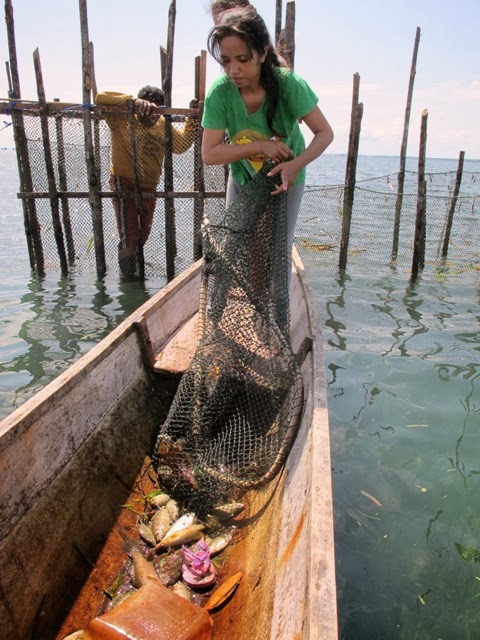
Sustainable fishing methods are often used by the locals and the inhabitants of Salawati (one of the four main islands of Raja Ampat) used underwater fishing cages called keramba.  Erected close to the beach with a tunnel at the front, fish were able to swim into the cage, but not back out.  When the locals required fish, they simply scooped out the live catch with a net and all infants were thrown back into the sea in order to mature.  Villagers also held sasi over the lobster, since according to folklore, the lobster once guided lost fishermen back to the shore – no-one is allowed to eat the lobster and if it is accidently caught in the net it must be thrown overboard.


Dinner in Salawati: the catch from the keramba nets is tossed into the boat

Yet Salawati’s hidden corals were also victim to illegal fishing practices and officers at a nearby Conservation International post explained that the reef by the post had been bombed in the past and was beginning to recover after years of surveillance. 

According to research by renowned marine scientist Gerald Allen, the locals are now applying non-sustainable fishing methods such as cyanide which is supplied to them by non-locals along with a squirt-bottle.  After CI scientists investigated the conditions of 45 coral reefs over 10 years ago they discovered that 13.3% showed evidence of destructive fishing practices.  Patrols and surveillance posts are crucial and CI has established many stations across Raja Ampat.  Even the idyllic region of Wayag was bombed in the past and only now, (under the protection of CI) has the area flourished with black tip reef sharks.  However, CI rangers explained that illegal boats from the Philippines were caught entering Wayag’s waters - these hunting boats were often armed and dangerous and packed with shark fins to trade illegally in Asia.
Due to global fishing pressures, nets are now being flung further East, into one of Indonesia’s last remaining paradises - Raja Ampat.  For hundreds of years the respectful islanders have lived in harmony with the marine world, yet in just the past 20 years this relationship has faced many strains.   A firm understanding of the impacts of bombing, coral destruction and fish stock depletion needs to be understood by every fisherman, before the paradise is lost.

Further Information

Conservation International: http://www.conservation.org/

McKenna, S.A., G.R. Allen, and S. Suryadi (eds.). (2002) ‘A Marine Rapid Assessment of the Raja Ampat Islands, Papua Province, Indonesia.’ RAP Bulletin of Biological Assessment 22. Conservation International

James Morgan’s documentary: http://www.jamesmorgan.co.uk/film/people-of-the-coral-triangle/

Sunday, January 5, 2014

How to make Virgin Coconut Oil - Recipe from East Timor

This is a recipe my old housemate taught me - her mother from East Timor (which separated from Indonesia in 2002) taught her how to make coconut oil which they used as a shampoo, moisturizer and for cooking. Before the coconut oil is prepared, the people of Timor believe that a prayer must be uttered over the shredded coconut so that enough oil can be produced to provide for the family.

I have used this coconut oil as a hair conditioner and as a toothpaste (mixed with equal amounts of baking soda.)  It is also useful for healing purposes - use it on cuts and bruises to speed up the recovery process.  The oil lasts for about four months.


Directions.

1) First of all choose how much coconut oil you want to make.  10 ground up coconuts will produce around 3 honey jars of oil.

2) Place the ground up coconut in a large bowl.  Add in drinking water so that the shredded coconut is slightly saturated (TIP: don't use too much water or the milk will be too diluted.)  Squeeze the water out of the shredded coconut with your hand and place the dry shredded coconut into a separate container to re-use.  Do this until the bowl is full of coconut milk.  Sieve the milk into a large wok.

3) Repeat this procedure again with the dry shredded coconut to produce another bowlful of milk.  (TIP: Do not use the shredded coconut more than three times in order to produce milk.  Two times should be sufficient.)  There is an Indonesian trick with the milk (leave it overnight - the milk will collect at the surface and the water will drop to the bottom and the milk can be separated with a spoon into the wok - this process is to avoid having too much water in the milk - if there is lots of water then the process of producing oil takes much longer.  However I have not tried this trick!)

4) Put the wok of milk on the stove with an adequate fire (if you use a small fire, this procedure will take a long time!)  If you use a large fire, remember to stir regularly (all the time, preferably!!) so that the milk doesn't burn at the bottom.  Use a wooden spoon.  Make sure you stir in the lumpy bits that collect on the sides of the wok.

5) The water will slowly evaporate away (when you stir the milk you will no longer be able to see any water.)  Without water, you must stir the milk non-stop - push the spoon up and down the wok and scrape the sides.  Soon you will begin to see the oil appearing above the white/yellow paste beneath.

6) The white paste will begin to turn brown.  Keep stirring but push the brown lumps with your spoon up onto the sides of the wok.  When all of the white paste has turned dark brown, turn off the stove and leave the oil to cool. 

7) Scrape the brown crumbs away from the oil.  Sieve the oil into glass jars. It takes some effort but it's a great alternative to unsustainable palm oil.  The brown crumbs can be eaten (TIP: try mixing the crumbs with sambal / chilli sauce to add a fresh, coconut taste.)


Tuesday, August 27, 2013

Raja Ampat - the Culture that Arose from 610 Islands

Every October, Raja Ampat hosts its annual cultural festival.  All of these photos were taken on the 18th October.  


Women perform the yosim dance with bamboo flutes and drums.  The traditional drum of mainland Papua is known as a tifa and is often made with the skin of the monitor lizard.  


Two men are adorned with the traditional accessories and body paint of Yenbekaki Village in Raja Ampat. The head dress is a made from a red bird-of-paradise which is protected on the island from hunting. Old stuffed birds like these are passed down from generation to generation, in mainland Papua, they are stored in bamboo containers and stored in the smokey roof - conservation groups provide 'moth balls' in order to preserve the specimens and prevent the need to hunt them.

Like the famous naturalist and explorer Alfred Russel Wallace, many tourists still flock to Raja Ampat to see these captivating birds of paradise.  Endemic to the islands of Waigeo and Batanta are Wilson’s Bird-of-paradise as well as the Red Bird-of-paradise.
Other birds worth spotting include: sunbirds, kingfishers, Papuan hornbill, cockatoos, parrots, the rainbow lorikeet, ospreys, egrets, the white bellied sea-eagle, Gurney’s eagle, hawks and owls.

The following article offers a good reason why you should come to Raja Ampat - quite simply it is the best place in the world to go snorkeling:
http://www.gonomad.com/2125-indonesia-s-raja-ampat-islands-the-best-snorkeling-in-the-world
In this article Larry Taylor describes his experiences of traveling through Raja Ampat on a shakti boat - an Indonesian, traditional vessel.

Weaver Ants Build their Castles in the Trees

In our back-garden in Papua, hidden in the vines and the orange tree is a hidden civilization.  Weaver ants are strange creatures that build vast networks of homes in the trees - using leaves!!  The nests are woven together and sealed with larval silk and colonies can include up to 100 nests. By firmly grasping and manipulating a larvae, the worker ants are able to bind the leaves together.
In Thailand, these leaf-larvae packages are even sold as food items in markets and the larvae are said to be high in protein. I think I'll pass on that though.

The simplest leaf design - a leaf folded upon itself and sealed at the edges. 

The worker ants have exceptionally good communication skills -using chemicals or tactile communication signals (such as body shaking.)

A more complicated nest design in a vine plant.  Some larger nests have been recorded as measuring half a metre in length.

Tuesday, December 20, 2011

Cheap and Eco-friendly Refrigerator


In our home we decided to make our own fridge from clay pots and below are instructions on how we did. It was cheap to do, costing us around IDR 200,000 and it’s good for the environment too. 

Nowadays fridges in Europe usually contain HFC-134a which does not deplete the ozone layer (although it is a greenhouse gas). This substance replaced CFCs which were responsible for depleting the ozone layer. However, in Indonesia I struggled to find a fridge which didn’t contain CFCs and I didn’t think that HFCs were a good alternative since all halocarbons are powerful greenhouse gases. 

So we researched alternative ways to keep our food cool and found out about an ancient type of fridge made of terracotta pots called a Zeer pot which is used across the Middle-East and Africa. A similar terracotta fridge is also used in Indonesia - our neighbour in Malang, East Java have a clay pot fridge which they sunk into the soil in their garden in order to keep it extra cold.
To make your clay pot fridge you will need:
Two unglazed terracotta (clay) pots
A bag of sand
A towel
Water
We found the clay pots in a market close to Brawijaya University in Malang, East Java.
The large outer pot - first we filled it with sand.
Then we placed a smaller clay pot inside and filled the sides with sand until the sand reached the tops of the pots.
After we had filled in the sand we poured water into the sand until it was moist. Then we placed a moist towel over the top of the two pots. Fruit, vegetables and cheese will now keep for up to a week. The sand needs to be watered once or twice a day. And voila... a new fridge.